9/10
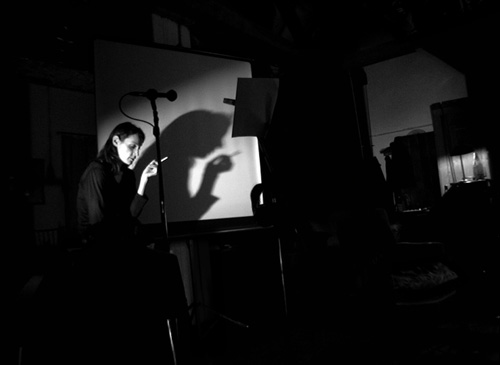
After watching Pedro Costa's first film recently (Ossos), I jumped ahead to his most recent because I thought it looked like something I would enjoy. It's a documentary in the loosest sense of the word, in that it's a movie featuring real people doing real things - in this case it's the French actress and vocalist Jeanne Balibar rehearsing, recording, and performing songs from a new album with her band. All conventional documentary elements (narration, interviews, background, context in general) are done away with, however. We're left with lengthy shots like this or this, with the start/stop soundtrack of a band attempting to coax music out of nothingness.
I guess how much you enjoy this hinges on how much you like the music but, despite having never heard anything from Balibar or her group before, I thought they were really interesting sonically, and Balibar has a great, smokey voice that lends perfectly to Costa's gorgeous black and white photography. The images and music together are extremely hypnotic, and I really liked the paradoxical dynamic Costa's shots induced...the studio space seems to be both claustrophobically enclosed and, because so much is cloaked in darkness, as wide open as the universe. I'd watch it again in a heartbeat.
The film started as a 12-minute short of the same name, which you can see on Youtube (part one here).
27 April 2011
Ne Change Rien (Pedro Costa, 2009)
23 April 2011
Possession (Andrzej Zulawski, 1981)
8/10
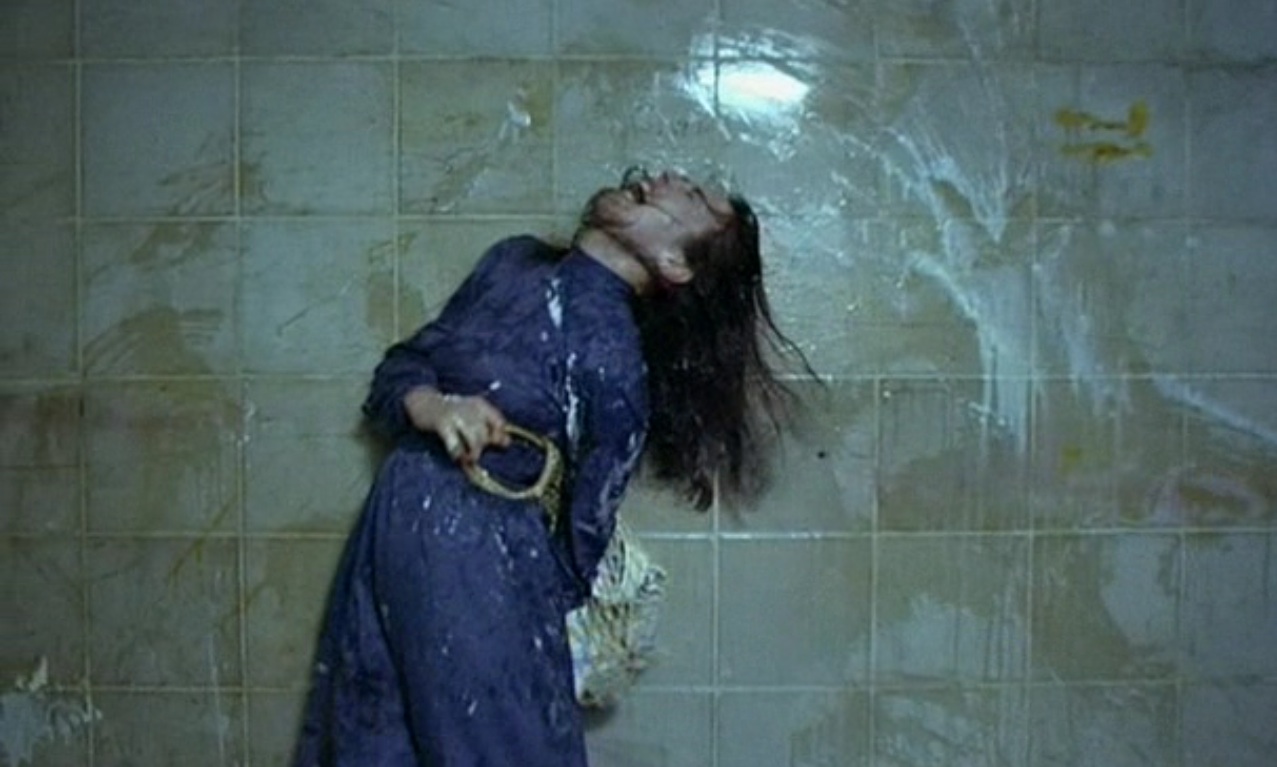
Speaking of ridiculously overwrought direction and acting...Andrzej Zulawski's Possession must be near the top of the list of the most completely over the top movies in the history of the medium. Every overly verbose line is struggled through by actors spitting them through heavy foreign accents...that is when they're not screaming, cutting themselves, shooting at others, or breaking things. Released in 1981, Possession is like of a weird mix of David Cronenberg's body horror, Antichrist and Rosemary's Baby. It also contains probably the best enactments of demonic possession I've ever seen, jaw-droppingly acted by Isabelle Adjani. A lot of stuff in this movie probably went way over my head, but I don't think anyone could possibly fully understand it except Zulawski himself. Heck of a ride though.
20 April 2011
Nostalgia For the Light (Patricio Guzman, 2010)
8.5/10
A really interesting, original documentary dealing with questions of astronomy, the Chilean desert, and the Pinochet regime. Telling how director Patricio Guzman pulls these disparate elements together in a coherant way would be taking away some of the magic, so I'll leave it up to you to go see it (preferably on the big screen, for the jaw-dropping astronomical shots). I have no idea how Guzman even conceived of such a project but thank god he did. Immensely enjoying.
18 April 2011
Crystal Voyager (David Elfick, 1973)
6.5/10
One of the most popular surf videos from the 1970's, Crystal Voyager is a loose documentary following George Greenough's search for isolated surfing locations and the construction of an enormous yacht to achieve this end. This is interspersed with shots of Greenough and friends riding waves in the California sun set to G. Wayne Thomas' gentle psych-pop tunes. The drawback is Greenough's narration, which sounds bored, flat and devoid of all human emotion. The main attraction is the 25-minute closer, shot with a camera strapped to George Greenough's back to create a "you are there" effect, slowed down and edited to Pink Floyd's "Echoes". Whether it's a brilliant piece of avant-garde filmmaking or the end result of a stoned, self-indulgent hippie with too much time on his hands is up to the viewer to decide but I thought it was quite lovely to watch.
Histoires Extraordinaires (Federico Fellini, Louis Malle & Roger Vadim, 1968)
7.5/10
A triptych of 40-minute films directed individually by Roger Vadim, Louis Malle and Federico Fellini, all based on Edgar Allen Poe stories.
Vadim's Metzengerstein starts out promising enough with Jane Fonda starring as the young Countess Metzengerstein who falls in love with a rival Baron (played by brother Peter) and accidentally kills him in an act of revenge, leaving her to cling to a mysterious black horse that seems to embody his spirit. The first half of the movie is weird and entertaining enough, with the Countess entertaining guests and holding (very mundane looking) orgies and festivities and whatnot, but the action screeches to a halt halfway through and the last half of the film is mostly Jane Fonda frolicking around with a horse until she decides to kill herself to reunite with the dead Baron. Okay then.
Malle's William Wilson involves the man of the title constantly haunted by a doppelganger of the same name, who usurps and prevents his evil deeds until Wilson (the original) fatally wounds the other. Told as he's dying that the original can't live without the double, and with no one believing his story, Wilson kills himself by jumping off a church bell tower. Brigitte Bardot shows up as Wilson's opponent in a decisive card duel that's far more entertaining than it should be, but overall this segment is pretty flat and uninteresting.
Fellini's Toby Dammit was long hyped to be the star of the show and it did not disappoint. Clearly sourced more from Fellini's brain than from any Poe work (it's based on his story Never Bet the Devil Your Head but it's hard to imagine it shares anything more in common than the title), this one centres around a celebrity film star named Toby Dammit who has indeed sold his soul, or at least his head, to the devil (magnificently cast as a young, attractive blonde girl) in exchange for the grotesque excesses of stardom. Visually stunning - I would be shocked if Terry Gilliam wasn't influenced by this when making Fear & Loathing - and constantly impaling the film culture as he did in 8 1/2, there is a lot to enjoy in this segment. Terence Stamp embodies the worn-out, drugged-out, apathetic Toby Dammit perfectly and the film manages to be genuinely creepy, something the other two never come close to achieving. Definitely worth seeking out in its own right.
Messiah of Evil (Willard Huyck & Gloria Katz, 1973)
6.5/10
Little known U.S. 1971 horror film by Willard Huyck and Gloria Katz, who would eventually go on to direct and produce Howard the Duck, effectively killing their film careers. Messiah of Evil shows lots of promise though, as its a visual overload of Technicolor flair and the set designs are fantastic. The plot is pretty humdrum (a woman visits a strange town to check up on her father quickly realizes things aren't what they seem blah blah) and the action is minimal, so anyone hoping for gore is going to be let down. The plot and execution is actually a lot like Carnival of Souls, maybe mixed with Suspiria's colours and sets and H. Gordon Lewis' Americana weirdness. A neat curio.
Ossos (Pedro Costa, 1997)
7/10
The first Pedro Costa movie I'd seen, and it was definitely a challenge. Not so much in its subject matter or figuring out what's going on, but just in the rigid distance that Costa puts between the characters and his audience. I admired it more than I enjoyed it, but I'm definitely intrigued enough to pursue the rest of his filmography.