16 March 2015

Children of Men (Alfonso Cuaron, 2006)

7/10
If you'd never seen Children of Men but only had to imagine it based on what you were told about it (the actors, a loose sketching of the plot, maybe the director), what you'd envision would be pretty much exactly the same as the final product. At least it was for me. I mean yeah it was good in just about all areas but didn't do anything particularly extraordinarily, although the initial concept and premise was intriguing. I don't normally care much for Clive Owen but he was a good fit here.
Speaking of extraordinary, the unbroken tracking shot at the climactic 'battle" scene is very impressive, but when the movie built up to an impressive trick of camerawork or direction instead of something that actually serves the story, it's hard not to feel like it's a bit showy and gimmicky. I mean yeah from a technical standpoint it was impressive but I feel like it was also there to make up for the fact that the movie didn't really have a whole lot to say in the end (or by the end) and this was just fancy window-dressing to obscure that fact.

12 March 2015

Goodbye to Language (Jean-Luc Godard, 2014)

4/10
My great shame is that I didn't see this in 3D, which is seemingly a sin on par with watching Avatar or Gravity on one's smartphone. I saw it in the officially-released 2D Blu-Ray version, so that still counts for something? I would like to see it in 3D, not because I enjoyed the movie but because apparently there's some pretty impressive and rule-breaking 3D shots that I think would be very interesting to see "for real". The way the movie is shot (by cinematographer Fabrice Aragno) is by far its strength as there's a real hypercolor beauty to a lot of the shots. Goodbye to Language is if nothing else a really strong and convincing argument for how beautiful digital filmmaking can be.
As for the movie itself, well, to me it's an arthouse Avatar. Avatar was beautiful but packaged with a dumb plot that a 5 year old could understand. Goodbye to Language is beautiful and packaged with a dumb plot that nobody on earth could possibly understand. Where Avatar quotes anyone-can-get-it fare like Dances with Wolves and Pocahontas, Goodbye to Language is its polar opposite, jammed with no-one-can-get-it references to Flaubert, Dostoyevsky, Rilke, Solzhenitsyn, Ellul and too many others. And if you stripped away the technical marvels of Avatar you were left with little of interest; the same, I think, applies to Goodbye to Language. Or at least it did for me. And maybe Godard wanted it that way too. But his movie still bored me to tears. Even after watching it in part or in whole three consecutive times (it's only 69 minutes long) and reading as much as I could about it, and deconstructing and piecing back together its twin narratives and double actors and obscure references, the value of the movie was almost entirely lost on me and I have my suspicions that it would have been lost on a whole lot of other people too if it didn't have the uncriticizable name of Jean-Luc Godard attached to it.
Nonetheless I do remain impressed that Godard has not gone quietly into his twilight years - this is a movie as provocative and impenetrable as anything released by any younger filmmakers out there, and it still could not have been made by any other filmmaker but Godard. Not many directors in their 80's have ever continued to try to push boundaries as aggressively as Godard has without dipping into self-parody at any point, and I have plenty of respect for that.

12 Monkeys (Terry Gilliam, 1995)

9/10
Ridiculous that I haven't seen this movie until now! I don't know what I was waiting for, it was on the "someday" list forever. I'd seen the movie that inspired it ages ago, Chris Marker's La Jetee, and thought it was really cool but I wasn't confident that using it as a jumping off point for a feature would work so well. I was wrong, it worked brilliantly, and 12 Monkeys is brilliantly scripted which certainly helps. The movie has a really similar feel to Brazil in both its paranoid plot and the way the films are shot, Gilliam certainly has an unmistakable style. I never really cared too much for Bruce Willis in anything but he was really great in this. Brad Pitt is more than a little over the top and his performance is off-putting at times (specifically when we first meet him) but is okay overall. I was going to ask what ever happened to Madeleine Stowe but it looks like she recently returned to acting on TV's Revenge, which I haven't seen. Overall a really great movie, even knowing the main "twist" of La Jetee doesn't spoil the fun of watching 12 Monkeys to the end because it's so expertly crafted, every scene leaves you wondering how they're going to get to what comes next and how they made a movie that teeters on the brink of insanity yet manages to make perfect sense.

10 March 2015

Force Majeure (Ruben Ostlund, 2014)

8/10
What a great title for this movie. Force majeure is legally defined as a "chance occurrence, unavoidable accident" (Wiki). Perhaps more relevant to the film, force majeure "[does] not excuse a party's non-performance entirely, but only suspends it for the duration of the force majeure" (Wiki again).
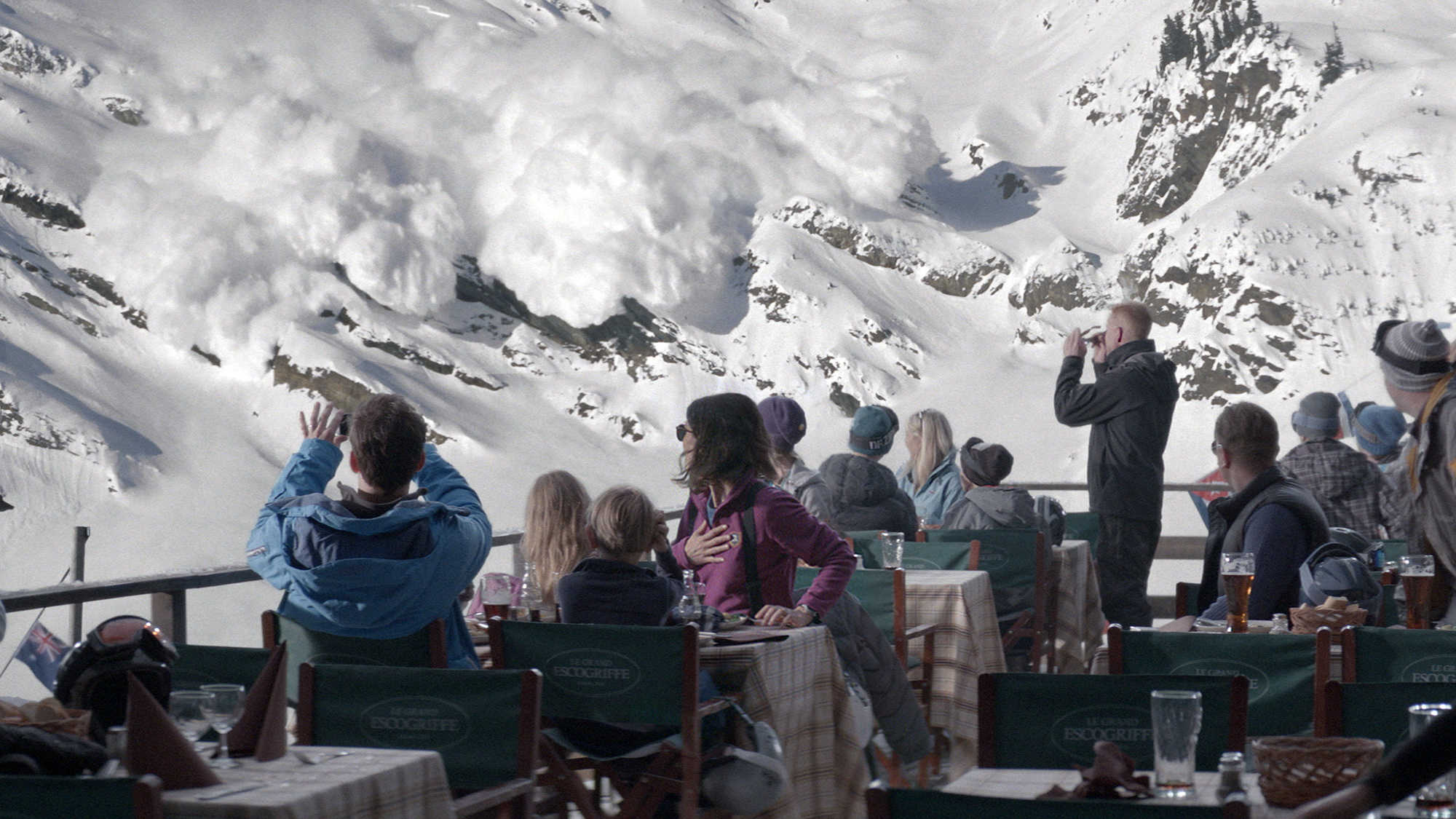
A near-miss avalanche that sees husband and father Tomas running for cover leaving his wife and 2 young children behind is the central concern of the film. For Tomas, the episode is little more than a story to tell at dinner; for his wife, it's a minor annoyance that slowly grows into a major impasse (a metaphorical avalanche so to speak): her perception of Tomas is permanently altered. The way this event is treated among the movie's characters was one of my favorite aspects of the movie. It's almost like an horror movie epidemic (underlined by the score's Hitchcockian string stabs), slowly infecting almost everyone who comes into contact with it: Tomas, his wife, their kids, their friends, and, more indirectly, an entire busload of people. Eventually Tomas is forced to confront his own actions, both to himself and to his children, pathetically staging a perilous situation on the ski hills where he can "rescue" their mother in front of them, an attempt to restore some kind of balance to their now-skewed family unit.
The movie makes for an interesting commentary on the fragility of not only our relationships but ourselves as people and who we are, or who we think we are. I found it very interesting to learn afterward that writer/director Ruben Ostlund came up with the movie after reading about a dramatically high rate of divorce among couples who survive major catastrophes.
The movie is beautifully shot, both in its ski resort interiors and mountain exteriors. I found it suffered from a similar "problem" as Ostlund's 2011 film Play - it presents a really interesting dilemma and asks some difficult questions that don't have easy answers, but ultimately there are niggling feelings of...incompleteness? Both movies were like reading a thought-provoking op-ed piece. I appreciate the questions they asked but I might have hoped for a little more closure and, once the questions are out there, it's hard to see much value in returning to the essay or film again. As much as I liked Force Majeure, I don't see a whole ton of value in repeated viewings, which maybe knocks its score down a notch for me.

02 March 2015

Maps to the Stars (David Cronenberg, 2014)

4.5/10
I'm still waiting for a David Cronenberg movie I really love as even his best efforts (The Fly, Videodrome) I've found overrated. He's a .200 director for me. Maps to the Stars probably isn't "best Cronenberg" by any metric. It's very reminiscent of his last, Cosmopolis, as it too feels angry and restless and makes some rather banal stabs and commentary about whatever Cronenberg was seemingly annoyed by on the day of shooting. But it's just as content to look pretty and it always does, given the gorgeous Hollywood interiors most of the movie is shot in.
The actors are the main draw here, especially Julianne Moore who is fantastic. Mia Wasikowska is fine too and I don't know who Evan Bird is but he was great as a snotty, punchable-faced spoiler child star.
As for the movie itself, it felt like David Lynch (speaking of) already critiqued everything said here with way more artistry and way more weirdness in Mulholland Dr. and Inland Empire. Maps wants you to believe it's weird and arty but it's not, really, and the ending proves that. Kind of like Cosmopolis, which started out weird and arty and ended totally boring. Mostly Maps is just kind of unpleasant, certainly not something worth revisiting any time soon.

Under the Skin (Jonathan Glazer, 2013)

8/10
I felt especially compelled to finally watch this after someone reviewed it here and said it reminded them of David Lynch and after seeing all those okayish Oscar movies I needed a blast of something weird. Well it didn't remind me too much of Lynch but I enjoyed it and it was certifiably weird at times, although ultimately told an interesting and rather depressingly tragic story. The "feeding" scenes, I guess you could call them, are monumentally impressive and hypnotic, and I found myself wishing the movie was made of more of those and less of Scotland (although the visuals are pretty impressive all around).
The movie felt like it lost a little steam at about the 3/4 mark and had a hard time transitioning from the middle to the end. It's not the masterpiece certain indie film websites keep telling me it is but it's a very cool and very original movie and I dig it.

Groundhog Day (Harold Ramis, 1993)

6/10
I'd never actually seen this before so I watched it on TV. It was fine but you know, don't have much to say about it. Guess I would have appreciated it more if I had seen it as a kid. For now I can't say it'll hold much of a special place for me.